That’s a very detailed and informative text! I’ll condense it into simple, easy-to-understand words, focusing on the main points about the job and the education needed.
🩸 Becoming a Blood Spatter Analyst (BPA)
A Blood Spatter Analyst is a special kind of forensic scientist who studies the blood patterns left at a crime scene.
They look at the size, shape, and spread of the blood to figure out:
- What happened: Like a detective, they reconstruct the event.
- How the wounds were made: Which weapon was used, or if they were self-inflicted.
- Where people were standing: The position of the victim and the attacker.
This job is vital because their findings can prove or disprove what witnesses say, helping to solve crimes.
🎓 What Education Do You Need?
To become a BPA, you need a strong science background.
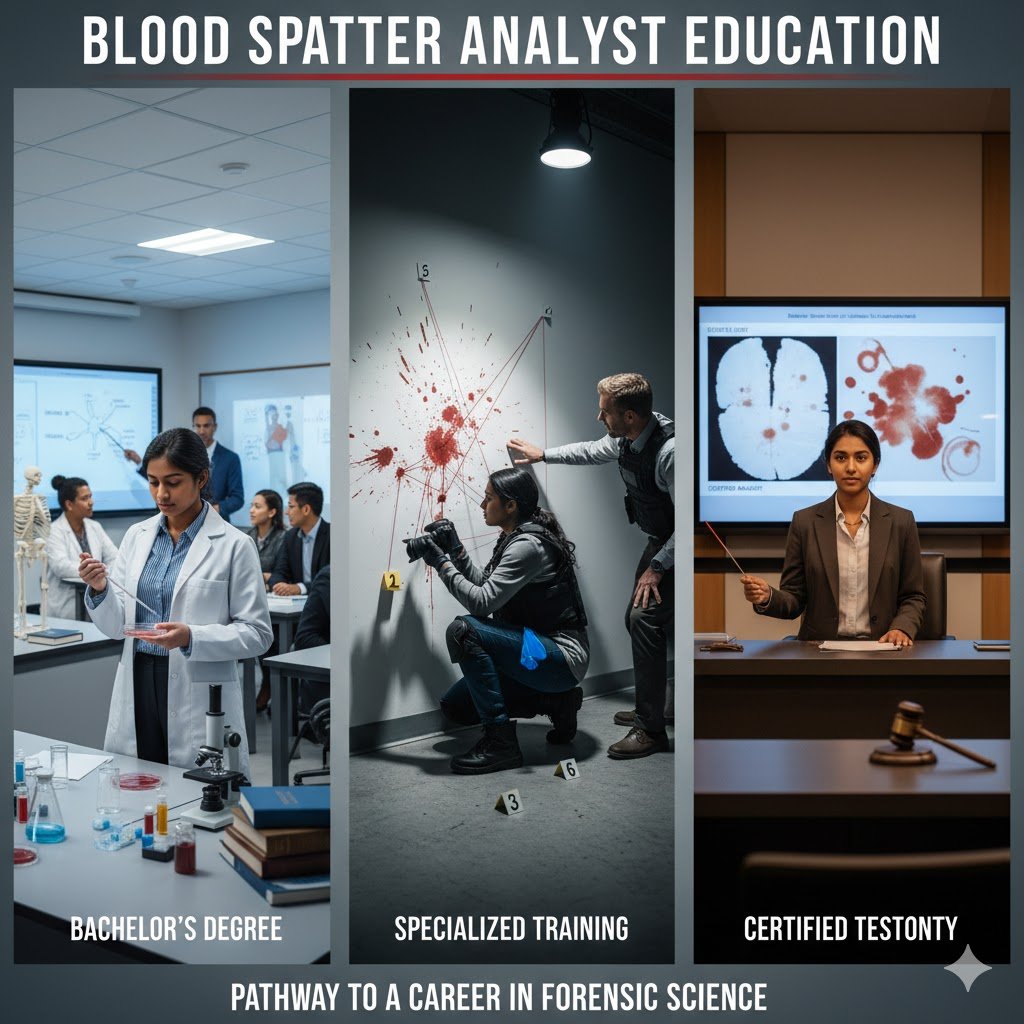
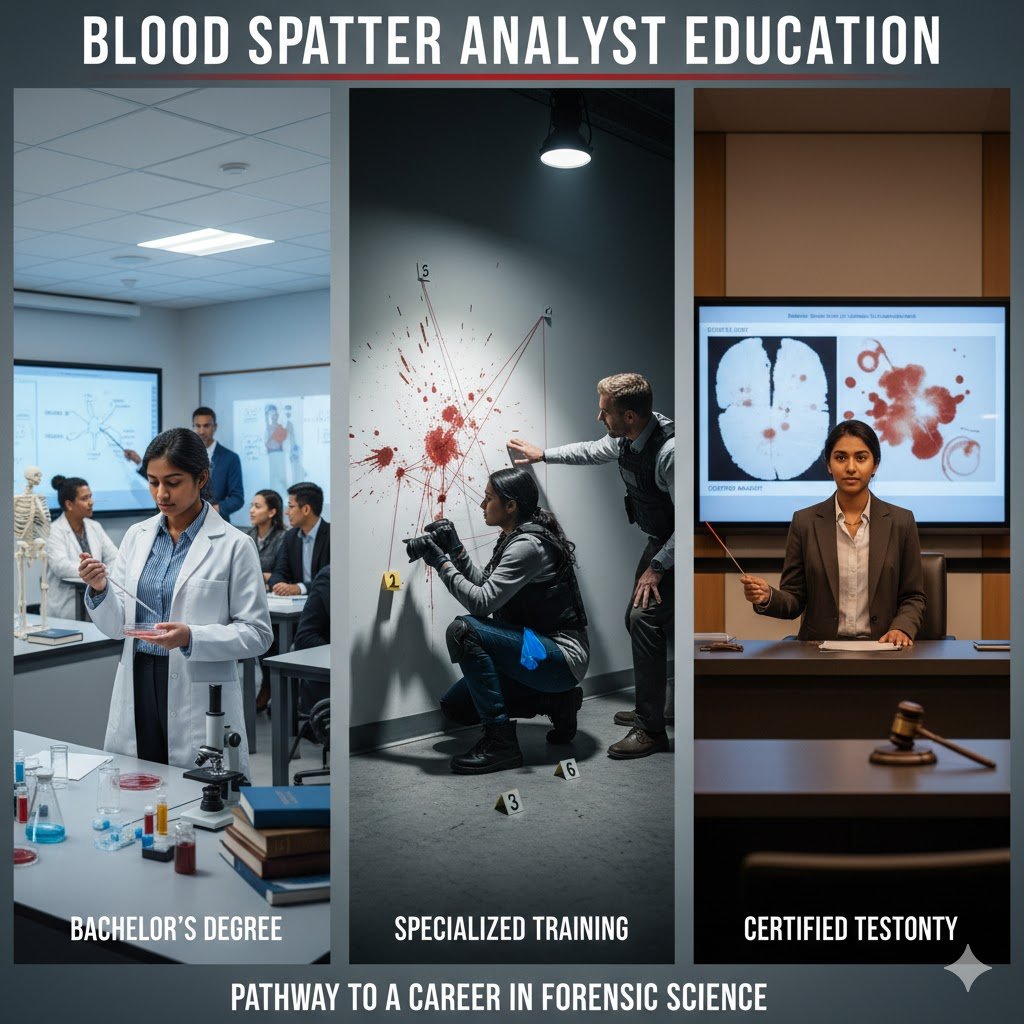
1. College Degree (Bachelor’s)
- Minimum Requirement: A 4-year degree is a must.
- Best Subjects: Choose Forensic Science, Biology, Chemistry, or Criminal Justice.
- What you study: You’ll learn about science (like the physics of fluids), how crime scenes work, and law.
2. Specialized Training
- After your degree, you must take specific courses on Bloodstain Pattern Analysis.
- These are often taught by groups like the FBI or the International Association of Bloodstain Pattern Analysts (IABPA).
- What you learn: How blood acts, how to photograph and measure bloodstains, and how to write reports for court.
3. Certification (Highly Recommended)
- Getting certified by organizations like the IAI or IABPA shows you are a professional expert. It usually involves experience, training, and passing exams.
🧠 Key Skills for the Job
To succeed, you need:
- Strong Science Knowledge: Understanding biology and physics.
- Attention to Detail: Small things matter a lot in this job.
- Good Communication: You need to clearly explain your findings to police and juries in court.
- Emotional Strength: You must stay calm and professional when dealing with difficult evidence.
📍 Where Do They Work?
Most BPAs work for:
- Government Crime Labs
- Police or Law Enforcement Agencies
- Private Consulting Firms
💰 Job Outlook
The demand for forensic science jobs is steadily growing. Analysts with good education and certification generally have the best chance of getting a job and earning a good salary (experienced analysts can earn well above $80,000 annually).
In short: If you love science, solving puzzles, and want to help with criminal justice, get a science degree, complete specialized training, and consider certification to start your career as a Blood Spatter Analyst.
Would you like me to find a list of top schools or training programs that teach Blood Spatter Analysis?
That’s a great idea! To help readers on their journey, here is a list of well-regarded educational and training options in forensic science, especially for those interested in Bloodstain Pattern Analysis (BPA).
🏫 Top Educational & Training Options for BPA
1. Undergraduate Programs (Bachelor’s Degree)
You should look for programs that are FEPAC-accredited (Forensic Science Education Programs Accreditation Commission) as this is the “gold standard” for quality forensic science education.
- Penn State University (PA, USA): Known for its comprehensive forensic science education with a strong scientific foundation.
- John Jay College of Criminal Justice (NY, USA): Offers a dynamic community focused on justice and forensic science.
- University of Central Florida (FL, USA): Offers programs with strong scientific and practical coursework.
- Virginia Commonwealth University (VA, USA): Combines the resources of a large public research university with specialized programs.
- University of Toronto (ON, Canada): Offers a Forensic Science Honours program.
2. Specialized BPA Training Courses
After a bachelor’s degree, specialized 40-hour Basic and Advanced BPA courses are essential for certification. These courses are offered by private and public organizations and often meet the standards set by the International Association of Bloodstain Pattern Analysts (IABPA) and the International Association for Identification (IAI).
- University of Florida (UF) – Principles of Bloodstain Pattern Analysis Laboratory: Offers in-person and online elective courses, including a hands-on lab component.
- Tritech Forensics Training: Offers a 40-hour Basic Bloodstain Pattern Analysis course designed for investigators, lab personnel, and crime scene technicians.
- Pinnacle Forensics & Forza Forensics: These and similar private firms offer IAI-approved 40-hour Basic and Advanced BPA courses that focus on practical exercises using animal blood.
- Cranfield University & Nottingham Trent University (UK): Offer short professional courses in Introduction to Bloodstain Pattern Analysis for ongoing professional development.
Note: The International Association for Identification (IAI) requires a minimum of 100 hours of BPA-specific training (part of 240 hours total) to qualify for their certification exam. The 40-hour courses listed above are typically the starting point for this requirement.
3. Professional Organizations (Certification)
These groups do not offer the degree, but they provide the essential training standards, certification, and networking opportunities.
| Organization | Key Role | Certification Offered |
| International Association for Identification (IAI) | Global organization that certifies forensic specialists. | Certified Bloodstain Pattern Analyst (CBPA) |
| International Association of Bloodstain Pattern Analysts (IABPA) | Focuses specifically on the science of BPA; provides training standards. | Does not certify, but its recognized courses are required for IAI certification. |
Choosing a degree from a FEPAC-accredited university and then completing IABPA-approved training courses gives you the strongest path to becoming a certified and successful Blood Spatter Analyst.
Would you like to know more about the specific coursework in a FEPAC-accredited forensic science program.